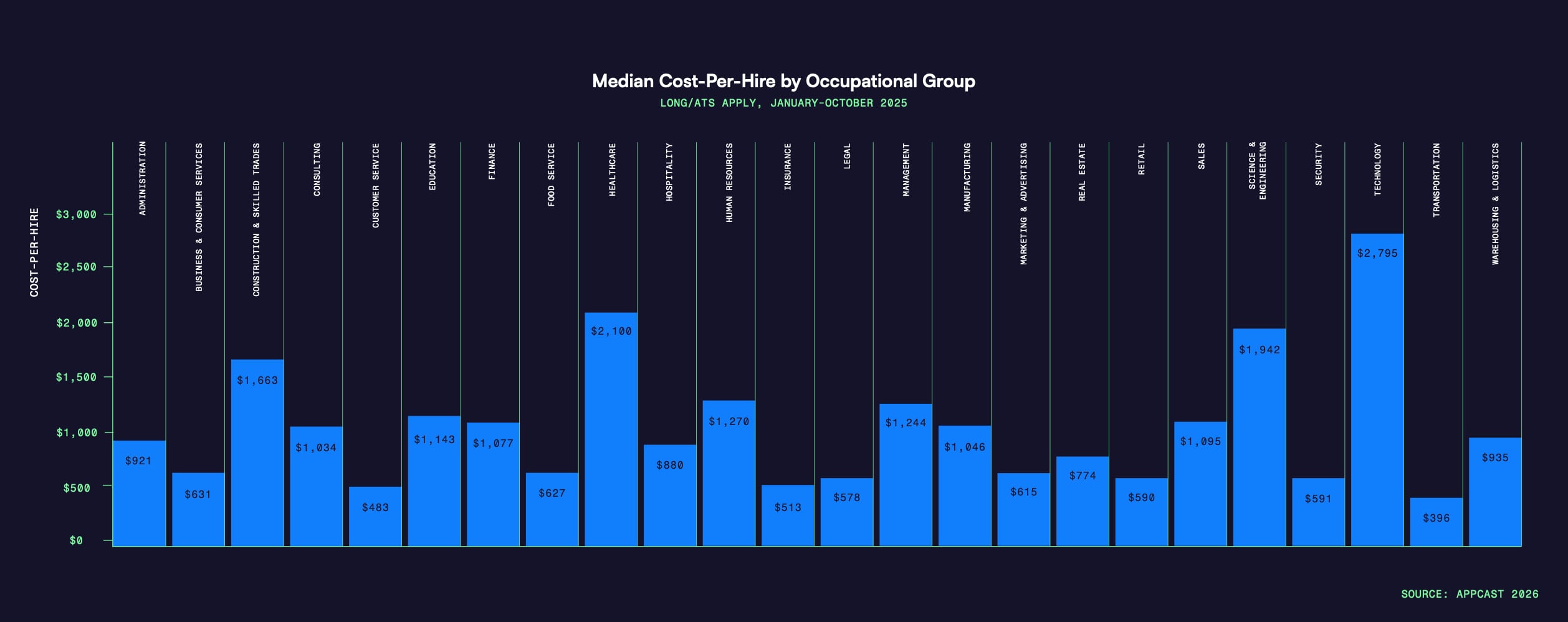
Healthcare recruiting has always been uniquely challenging, but in 2025, it became its own universe. Apply rates dropped while cost-per-click (CPC) and cost-per-application (CPA) rose. And cost‑per‑hire continues to sit at the very top of the occupational landscape.
If you’re hiring nurses, clinical staff, or allied health professionals in 2026, here’s what our data shows.
Healthcare remains the most expensive sector to hire for
Even as the broader labor market softened, healthcare hiring costs stayed stubbornly high. Why?
Because the problem is supply, not demand.
There simply aren’t enough qualified healthcare workers to fill the volume of open roles. Low apply rates push CPAs higher, and even when applications come in, conversion is hard. Screening requires credentials, licensing, and role‑specific experience — all of which gate the candidate pool.
Healthcare’s high CPH reflects scarcity, not recruiter inefficiency.
Apply rates dropped while other “sitting‑down” roles surged
Apply rates for “sitting down” roles climbed sharply in 2025, but healthcare continued to trend downward.
That divergence shows two things:
- Healthcare workers are still in demand everywhere.
- The labor market slowdown didn’t reach them.
If you’re competing for RNs, CNAs, medical assistants, or technicians, expect the competition to remain crowded.
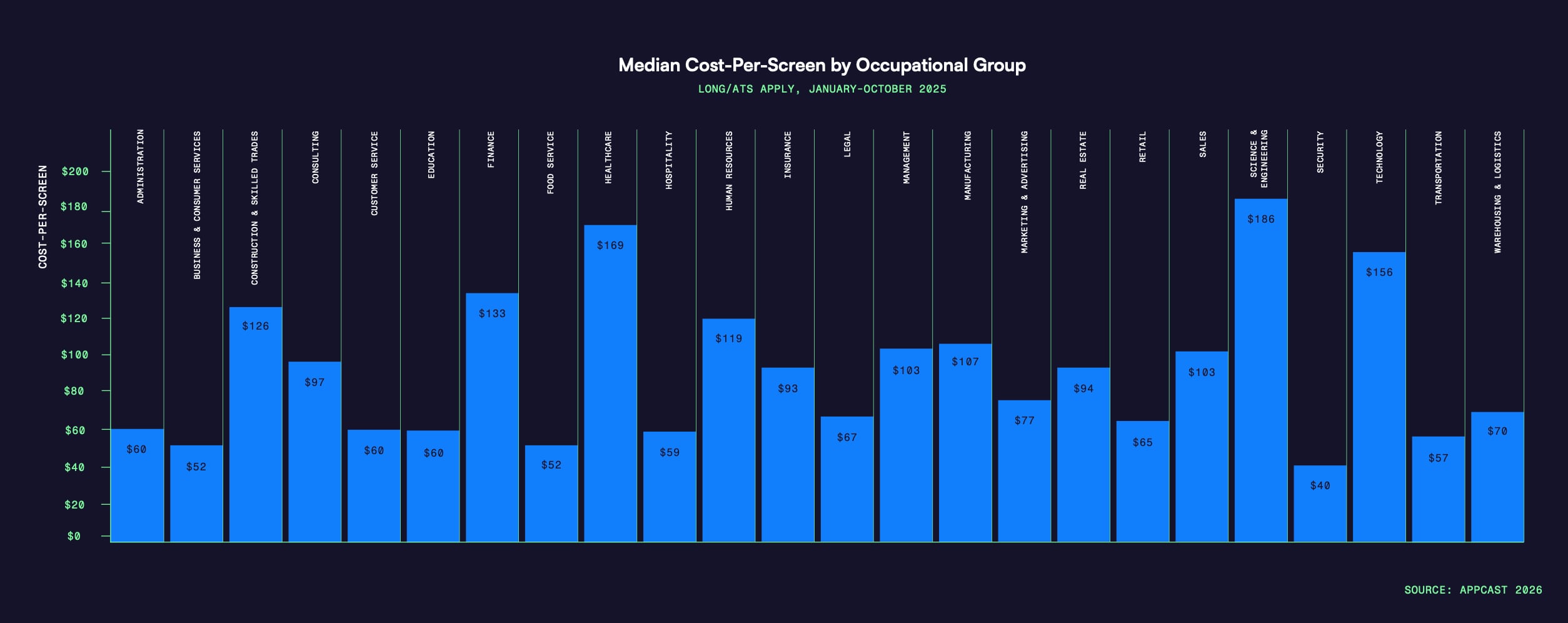
Screening costs are among the highest of any occupation
Healthcare has one of the highest cost‑per‑screen benchmarks. The reason is simple: Qualification requirements are stricter, and the number of candidates who meet them is small.
That means more spend to surface the right people and more recruiter time verifying credentials.
Why demand will stay high in 2026
Demographics continue to push healthcare hiring higher:
- An aging population
- Ongoing nurse shortages
- Increased care complexity
- Burnout and turnover
Even with a soft labor market in other sectors, healthcare continues to operate on a different curve.
Employer Branding: The healthcare hiring advantage
Employer branding has become a critical differentiator in healthcare recruiting, where there is intense competition for a limited pool of qualified candidates.
New Appcast data from more than 3,200 healthcare workers shows that organization reputation ranks nearly as important as compensation, and professionals rely heavily on channels like career sites, Google, and Indeed to evaluate employers—meaning every touchpoint shapes their perception before they even apply.
Strong brands also reflect employee’s values: purpose, culture, stability, supportive leadership, and burnout‑reducing conditions, all of which define the modern healthcare worker’s ideal environment.
Together, the data makes clear that employer branding isn’t just marketing, but a core strategy for attracting and retaining talent in the most competitive labor market in America. A full report from Appcast will be coming soon to unpack these insights even further.
How organizations can improve healthcare hiring performance
1. Prioritize speed
Healthcare roles often have multiple employers chasing the same candidates. Whoever moves candidates to screening and interview fastest usually wins.
2. Lean into search and social
Search captures the smaller active talent pool while social expands reach into the larger passive talent pool.
3. Build your employee brand
Employee branding is a great way to differentiate yourself against your competitors and attract qualified applicants.
4. Use salary transparency to compete
Compensation is a major differentiator for healthcare candidates, who are comparing multiple offers.
5. Shorten your apply process drastically
Healthcare candidates have options. A long apply flow is an easy reason to abandon your job for another employer’s.
Healthcare recruiting is hard but winnable
It requires more thoughtful funnel design, more targeted media strategies, and more competitive employer value propositions. But the employers who adapt quickly — and use metrics to guide decisions — will be the ones who attract and retain scarce healthcare talent.
To learn more about how healthcare recruiting compares to other indsutries, download Appcast’s 2026 Recruitment Marketing Benchmark Report.
Key Takeaways
Persistent Scarcity: Healthcare recruiting faces ongoing shortages, keeping costs high.
Screening Complexity: Strict credential requirements elevate screening expenses.
Demographic Pressures: An aging population and nurse shortages sustain demand.
Strategic Adaptation: Speed, salary transparency, and streamlined processes are essential.
Data-Driven Success: Leveraging metrics helps organizations win in the most competitive labor market.
FAQ
What makes healthcare recruiting uniquely challenging?
Healthcare recruiting faces persistent talent shortages, strict credential requirements, and high costs per hire, making it more challenging than most other sectors.
Where can I find more information or resources on healthcare recruiting strategies?
Visit Appcast’s Recruitment Marketing Benchmark Report for detailed data and actionable insights on healthcare recruiting.
How can employers take action to improve their healthcare recruiting results?
Employers should prioritize speed, embrace salary transparency, utilize both search and social channels, and simplify the application process to attract qualified healthcare candidates.
How does healthcare recruiting compare to other industries in terms of hiring costs and challenges?
Compared to other sectors, healthcare recruiting consistently experiences higher costs and greater screening complexity due to ongoing shortages, credentialing, and demographic pressures.