
Even with rising recruiting costs and shifting labor dynamics, one thing hasn’t changed: job ad content still has a measurable, direct impact on apply rates.
This year’s data confirms several long‑running best practices, while revealing new shifts in candidate behavior. If your goal is to drive more efficient applications, here’s what you should prioritize.
1. Short, focused titles still win
Titles in the 4 to 6-word range deliver the strongest apply rates. When titles get longer than 10 words, apply rates drop.
Avoid titles stuffed with internal jargon or descriptors. Keep it clear, concise, and candidate‑friendly.
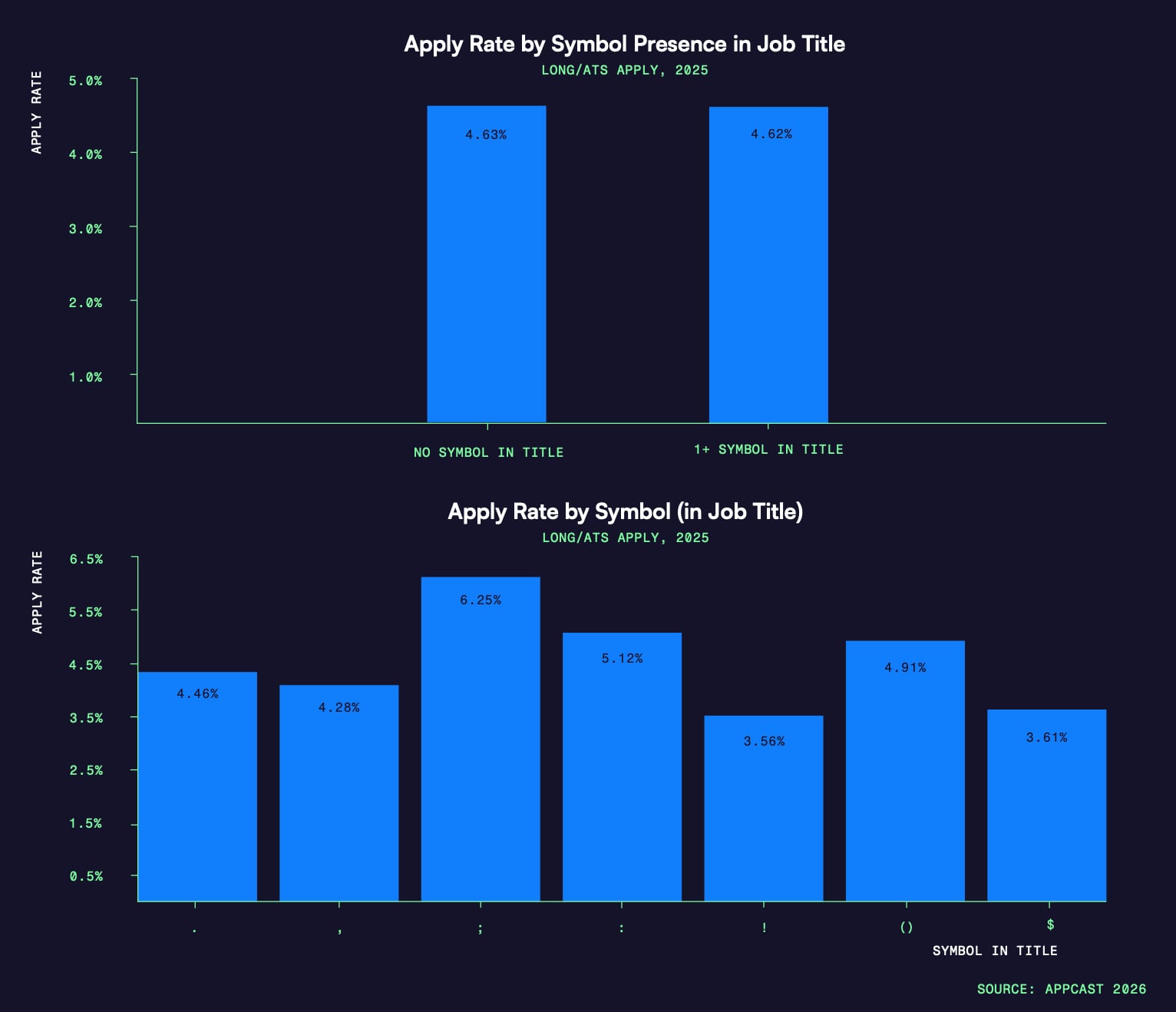
2. Symbols aren’t the villain but they’re not a silver bullet
Last year, symbols clearly hurt apply rates. This year, the impact is more nuanced. Some symbols (like “$”) can uplift performance when tied to pay transparency, while others (“!”) can feel spammy.
To keep candidates engaged, you can use symbols – but sparingly and only when they are necessary and add meaning.
3. Salary transparency leads to higher apply rates and lower CPAs
Jobs that include salary info consistently outperform those that don’t. Transparent job ads:
- Receive more clicks
- Have higher apply rates
- Often see lower CPAs
Even if some candidates self‑select out, the ones who apply are more aligned on expectations — saving you downstream screening time.
When possible, add a salary range. It improves both efficiency and candidate trust.
4. Remote work has lost its shine
In 2021 to 2023, “remote” or “hybrid” tags were the key to high apply rates, but not anymore. With remote roles dropping, the label is no longer a universal magnet.
Apply rates still tick slightly higher for remote roles — but they no longer guarantee a flood of applicants.
In your job descriptions, continue to use remote status as a clarity signal, not a performance lever.

5. Keep the initial apply process under five minutes
Jobs with short apply flows (1–5 minutes) convert far higher than those with 10+ minute apply times. Candidate tolerance for long forms hasn’t improved — in fact, with workers applying to more roles, patience is even lower.
To keep your apply process efficient, move anything non‑essential (cover letters, assessments, long questionnaires) later in the funnel.
6. Post early in the week — especially Monday
Nearly 20% of applications land on Monday and apply activity tapers as the week goes on. Posting early maximizes visibility while your ad is still “fresh.”
For the most eyes on your job ads, make Monday your posting day.
7. Job Ads Have a Short Shelf Life
More than half of all applications arrive within the first ten days of a posting. After that window, apply volume drops quickly. Fresh content is prioritized on job boards, and job seekers favor newly posted roles.

The bottom line: Content that converts is content that respects the candidate
This year’s trends point toward a simple truth: Candidates reward clarity, relevance and efficiency.
Job ads are still one of the highest‑impact levers a TA team can pull. In a year where recruiting costs are rising, optimizing your content is one of the most powerful ways to reclaim efficiency.
For a full breakdown of job ad content best practices, as well as additional data to help you meet your hiring goals in 2026, download the full 2026 Recruitment Marketing Benchmark Report.